
Climate Change Is Real:
Why Conflict-Affected Regions Face the Greatest Risks
May 2026
This blog marks the beginning of a series exploring the intersection between climate change, conflict, and fragility.
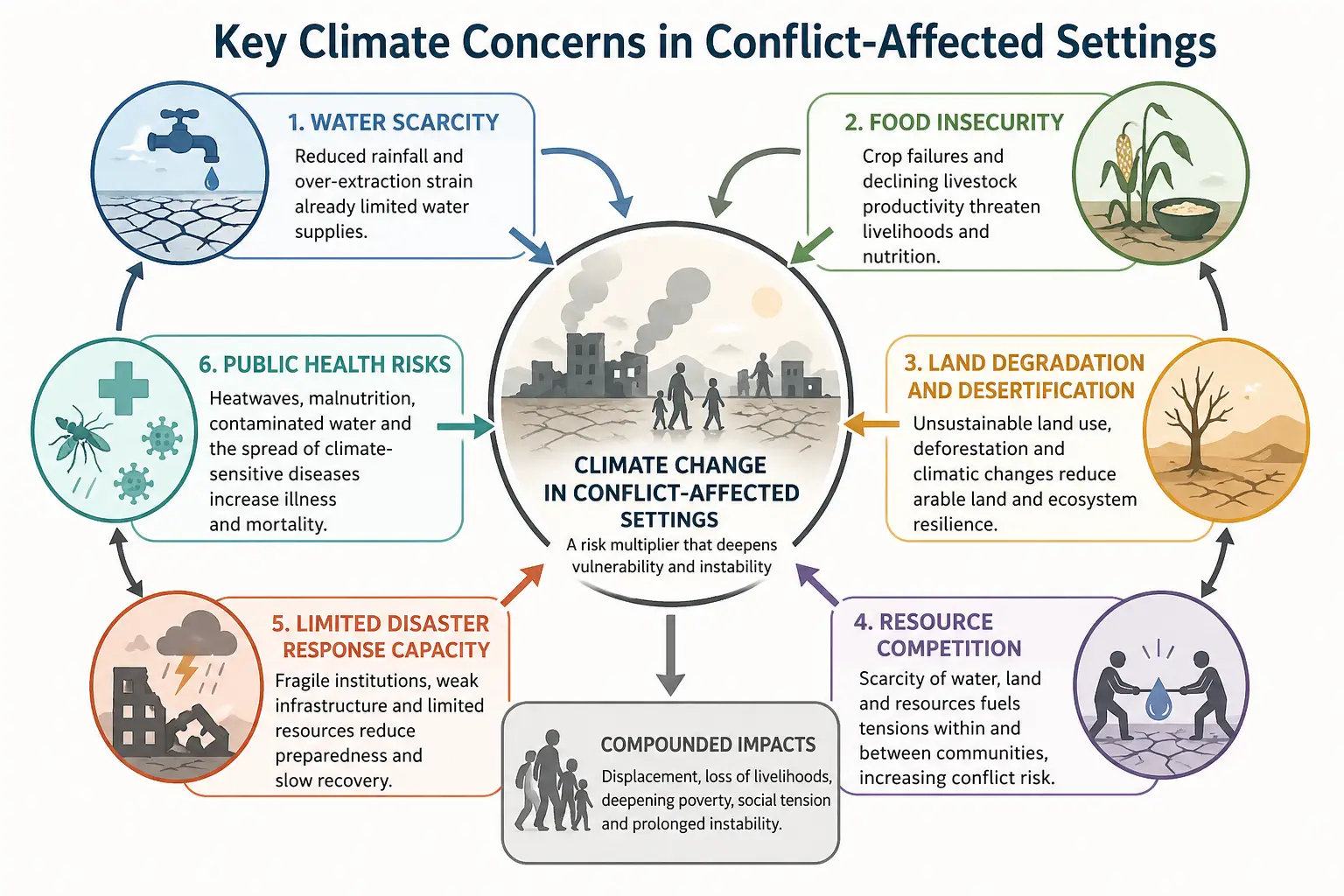
Across the upcoming blogs, five key climate-related concerns in conflict-affected settings will be examined in greater depth: water scarcity, food insecurity, land degradation and desertification, resource competition, and limited disaster response capacity, alongside their implications for public health and human security.
Through examples from countries such as Afghanistan and Sudan, this series aims to highlight how climate change is increasingly shaping humanitarian crises, displacement patterns, and local instability, while also exploring possible pathways towards more sustainable and conflict-sensitive responses.
Climate change is no longer a distant or abstract threat. Its effects are visible across the globe — from rising temperatures and prolonged droughts to increasingly frequent and intense extreme weather events. The scientific consensus, reinforced by assessments from the Intergovernmental Panel on Climate Change, leaves little room for doubt: human-induced climate change is reshaping environmental systems at an unprecedented pace. Recent synthesis reports highlight that global surface temperatures have already risen by approximately 1.1°C above pre-industrial levels, with cascading impacts across ecosystems and human systems.
Yet, while climate change is global, its impacts are deeply unequal. As emphasised by the United Nations Environment Programme, vulnerable and conflict-affected countries face disproportionately higher risks despite contributing the least to global emissions. Nearly 70% of the world’s most climate-vulnerable countries are also among the most politically and economically fragile. In these contexts, climate change is not simply an environmental issue — it is a risk multiplier that exacerbates existing crises and complicates pathways towards peace, development, and stability.
Climate Change as a Risk Multiplier in Fragile Contexts
A growing body of research, including analyses by the World Bank, demonstrates that climate change interacts with fragility, conflict, and violence in ways that intensify insecurity. Weak governance structures often lack the capacity to respond effectively to environmental shocks. Infrastructure — such as irrigation systems, roads, and water networks — is frequently damaged or underdeveloped, limiting both immediate response and long-term adaptation.
Displacement further compounds vulnerability. According to the Internal Displacement Monitoring Centre, millions of people are displaced each year due to climate-related disasters, many within already fragile contexts. Livelihoods — particularly agriculture and pastoralism, as highlighted by the Food and Agriculture Organization — are highly climate-sensitive, making communities especially vulnerable to environmental change.
In Afghanistan, recurrent droughts and floods have displaced hundreds of thousands of people, particularly in rural areas where communities depend heavily on subsistence farming and pastoralism. Severe drought conditions in provinces such as Badghis and Balkh have resulted in livestock deaths, crop failures, and the collapse of rural livelihoods, forcing families to migrate internally in search of water, food, and economic survival.
Similarly, in Sudan, prolonged drought, desertification, and environmental degradation have intensified displacement patterns already driven by conflict. In regions such as Darfur and eastern Sudan, shrinking grazing lands and water scarcity have undermined pastoral livelihoods and increased tensions between farming and pastoralist communities. Environmental pressures, combined with ongoing violence, have contributed to one of the world’s largest internal displacement crises. Sudan and Afghanistan remain among the countries with the highest numbers of displaced populations globally.
Livelihoods in both contexts remain highly vulnerable to environmental shocks and policy changes. In Afghanistan, for example, the Taliban’s 2022 ban on poppy cultivation significantly affected rural livelihoods, particularly for farming communities already struggling with drought, poverty, and limited economic alternatives.
Key Climate Concerns in Conflict-Affected Settings
- Water scarcity
- Food insecurity
- Land degradation and desertification
- Resource competition
- Limited disaster response capacity
- Public health risks
The International Committee of the Red Cross highlights how these overlapping risks are already overwhelming coping systems in conflict zones.
Irresponsible Mining: An Overlooked Climate and Conflict Driver
One often underexamined factor within the climate-conflict nexus is irresponsible and unregulated mining. In fragile and conflict-affected settings, extractive activities — whether artisanal or industrial — are frequently poorly governed, environmentally damaging, and closely linked to conflict economies.
Mining contributes to climate change and environmental degradation in several ways. Deforestation to clear land for mining reduces carbon sinks, while the extraction and processing of minerals can generate significant greenhouse gas emissions. In addition, mining operations frequently contaminate water sources and degrade soil quality, undermining agricultural productivity and ecosystem resilience.
In conflict settings, these impacts are magnified. Weak regulation allows environmentally destructive practices to proliferate, while revenues generated through extractive activities can fuel armed groups or reinforce elite capture of resources. The United Nations Environment Programme has documented how environmental degradation linked to extractive industries can exacerbate both climate vulnerability and conflict risk.
In parts of Afghanistan, unregulated mining of coal and rare earth minerals has contributed to land degradation and water pollution, placing additional strain on already vulnerable rural communities. Similarly, in Sudan, informal gold mining has contributed to deforestation, mercury contamination, and localised conflict over resource control.
Irresponsible mining, therefore, represents a critical intersection between environmental harm, climate vulnerability, and conflict dynamics. Addressing this challenge requires stronger governance, improved transparency in extractive industries, and the enforcement of environmental standards — even within fragile and conflict-affected settings.
Bridging Climate Action and Conflict Sensitivity
Effective responses must integrate climate adaptation, resilience-building, and conflict sensitivity. Supporting sustainable livelihoods, strengthening local governance, and improving natural resource management are all essential components of long-term resilience.
At the same time, the current decline in global development assistance requires renewed thinking about how communities in climate- and conflict-affected contexts can be empowered to respond more effectively to environmental and humanitarian crises. Greater investment in locally led adaptation and community-based resilience mechanisms will be essential moving forward.
Depoliticising Climate Finance: A Critical Way Forward
Climate finance remains uneven and, in many cases, highly politicised. Institutions such as the Green Climate Fund and the Global Environment Facility play important roles, but access for fragile and conflict-affected states remains limited.
Depoliticising climate finance — by prioritising vulnerability over geopolitical interests, simplifying access mechanisms, and ensuring long-term commitments — is critical. This is particularly important for addressing cross-cutting issues such as environmental governance in mining, which require sustained and coordinated investment.
However, depoliticising climate finance should not be interpreted as adopting a non-principled approach. A principled approach to climate financing means ensuring that financial resources are allocated equitably, transparently, and according to vulnerability and need rather than political interests. It also requires prioritising locally led adaptation, accountability, long-term resilience, and support for communities most affected by climate change and conflict.
Conclusion
Climate change is not only real — it is fundamentally reshaping risk landscapes across the world. In conflict-affected settings such as Afghanistan and Sudan, climate change amplifies fragility, deepens inequalities, and fuels instability over the long term.
Irresponsible mining adds another layer to this crisis by linking environmental degradation with conflict dynamics and climate vulnerability. Addressing these interconnected challenges requires integrated solutions, equitable financing, stronger governance, and more inclusive policy responses.
This blog has highlighted the importance of research, open dialogue, and integrated approaches in responding to climate-related risks in fragile settings. Without such efforts, climate change will continue to entrench instability in some of the world’s most vulnerable regions, with consequences extending far beyond national borders.